Showing posts with label 4.5 stars. Show all posts

Wednesday, 6 October 2010

Five Again Take Three.

Take Three of about a million and a half, at this rate. I've watched four more films since the last one, so I'm not really getting far ahead...


This was unexpected. I've watched most of David Lynch's films (with Eraserhead coming up, it leaves Inland Empire and Dune as the only two features left - I finished reading Dune a month or two ago, so I'll have to hit that up some time.) Known for his crazy, dense, almost incomprehensible films, The Straight Story was a blast from left-field for Lynch, being, as it were, a straight story. Simply, it is the story of Alvin Straight, an old man who travels six weeks on a ride-on lawnmower to visit his dying estranged brother. Going blind and with only minor use of his legs, it is a heartwarming story of tenacity and family, and the personal rewards that come from doing something everyone says you can't. Richard Farnsworth was Academy Award nominated for his role, and was backed up very well by Sissy Spacek as his mentally disabled but very bright and caring daughter. A beautiful story well told, and a surprising entry into David Lynch's catalogue, further cementing his 'great' status. 4 stars.


The DVD for Brighton Rock was another floating around the living room when I didn't have anything to watch, and I'd heard something about the remake in the preceding few days, so I thought I'd check it out. And it was quite good. A very young Richard Attenborough takes on the lead role of Pinkie in this inter-war crime film set in the eponymous English seaside town of Brighton. Pinkie is the precocious leader of his gang, showing very little fear in the face of anything that comes his way, who marries beautiful waitress Rose (Carol Marsh) to keep her quiet. As he starts to lose his grip on his gang and on the Brighton scene, he becomes more and more desperate and violent. Attenborough is terrifying in his role, precipitating a long and fruitful career both in front of and behind the camera. The remake (or should I say readaptation of Graham Greene's source novel) doesn't seem to be getting the same props as this 1947 production, so it's well worth checking out. 4 stars.


Ah, Harmony Korine and Lars von Trier. Dogme 95 was previously explored here, and looked at Korine here. Korine (uncredited) was writer and director on Julien Donkey Boy, the sixth entry in the Dogme 95 movement, about a severely dysfunctional family comprised of undiagnosed schizophrenic Julien (Ewen Bremner), his sister Pearl (Chloe Sevigny) who is also carrying Julien's child, his brother Chris (Evan Neumann) and deranged father (Werner Herzog - brilliant.) It's a wholly disturbing film complete with the Dogme look of verging-on-amateur, though the gravity of the story and depth of the performances ensures you're never fooled into believing this is anything but the real thing. Korine has a way of making films that are quite physically unsettling, and I find them often quite hard to sit through, though that isn't to take away from the power of his stories. 3 stars.


1969 - what a year. Costa-Gavras' Z powered into the Oscars with five nominations, including for both Foreign Language Film and Best Picture, taking home both the former and Best Editing. A not-so-subtle indictment of the Greek government at the time (though officially a work of fiction, I believe, with a starting disclaimer that any resemblance to real life is entirely deliberate), the film examines judicial and governmental moves to silence a burgeoning leftist movement in the unnamed country (again, definitely meant to be Greece, though the film was primarily shot in Algiers and is in French...) It's a brilliant piece of filmmaking, throttling the viewer with its viewpoint and forcing your engagement every step of the way. I'm not familiar with the rest of Gavras' work, but I'm definitely keen to rectify that. 5 stars.
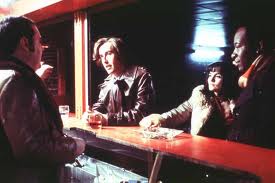

In my head, 24 Hour Party People was a totally different film. I can't think now of what I was getting it confused with, but it certainly wasn't what I watched, which is why I put it off for so long. The story of the Manchester club and music scene in the late 80s and early 90s, the film primarily focuses on Tony Wilson (Steve Coogan), a journalist who becomes a budding promoter and club owner, brought up and down by his own hedonistic decadence and belief in himself, at the same time seeming to compromise the very vision he pioneered and propagated. Looking also at the rise and fall of bands such as Joy Division, Happy Mondays and New Order, it is a fascinating and very entertaining look at this time, filled with frequent fourth wall breakages to insert actual memories and commentary on the time. Director Michael Winterbottom and writer Frank Cottrell Boyce both work splendidly to create this masterful biopic of an era, as told through one man. 4.5 stars.

Monday, 4 October 2010

Round Two of Five At Once.

Right, I'm fairly well on record on not being Christian Bale's biggest fan, but this DVD was fanging about in the living room and I had nothing to watch and I kept hearing such great things about, and about his performance (I'd heard similar things about his showing in American Psycho, and we all know how that panned out...) I think the points given to him in The Machinist are for his weight loss, which yes, while demonstrating incredible commitment, also demonstrates a level of insanity - boy, that's going too far. And he still seemed like Christian Bale. Emaciated, but still him. An interesting tale of being haunted by your conscience, it might have played better if Fight Club hadn't done such a bang up job a few years earlier. I remember being a little scared in a few points, but I shit myself over anything. 2 stars.


Have I mentioned that I love Atom Egoyan's name? Yes, I think I might have here. His name will always draw me to his films. Of course, whacking Julianne Moore in there is going to go a long way towards me heading out to see it also. I liked The Sweet Hereafter, but not so much Chloe. It was fine, I guess, but it didn't grab me the same way. The family drama was all a little off. Moore was terrific, as always, but I didn't quite gel with Amanda Seyfried and Liam Neeson. I just don't think they quite worked. (Max Thierot was cute though...) And the cerebral nature of everything kept it all a little cool and distant - the white rooms and glass everywhere, I can see where it was going with the kind of sterile environment and how that plays against the drama within, but it was all a little too much. It was a fine film that could have been great but in the end I feel that it missed it because of lazy visual cues. 2.5 stars.


Man, I totally don't even know where to start with Aguirre: Wrath Of God. Werner Herzog is one crazy, crazy guy. Like, seriously. Nuts. Brilliant, but loopy. I definitely don't think I can contain all that is this film in such a nutshell. Klaus Kinski is the titular Aguirre in a South American expedition to find El Dorado. He takes charge, seizes power if you will, and leads his troops or whatever onwards against all common sense, coming under attack from all sides, until eventually his men are hallucinating and he is proclaiming himself the wrath of god whilst covered in monkeys. No, really. Herzog really laid the groundwork for many of his latter films with this one. Kinski is terrifyingly mad, Herzog is terrifyingly creative, and the film somehow works for it all. It's mental, absolutely mental, but such a riveting piece of filmmaking, and seemingly such an influence on films such as Apocalypse Now (I'm seeing it - anyone else?)(In looking back, that's another film I watched and didn't write up. Damn.) 4.5 stars.


This is a film I really want to spend time on. But I must be strong. Abbas Kiarostami is a genius, he really is. I really enjoyed Close-Up, I loved loved loved Taste of Cherry, and now I really liked Ten as well. His is an oeuvre I really need to explore in much more depth, and repeatedly. Here, he has ten episodes of customers (or a son) in the passenger seat of a van, driven by their psychologist, who is interacting with her as she drives them around Tehran. It's such a simple concept, all taking place within the car, but it is a masterclass in what can be achieved with so little, and so simply. It is truly beautiful and a wondrous look at the often ignored stories of the women in this part of the world, opening them up not as victims of repression but as people just like the rest of us. Without it ever feeling like that is what is going on. Truly marvelous. 5 stars.


The major thing I can say about Food, Inc. is that is has changed the way I eat. Literally. I pay so much more attention to it now. To where my produce is coming from. To its content. I'm shopping more at farmer's markets when I can, but when I can't I'm doing everything within my means to make sure I pay attention to the lessons learnt from this film. Because they are many. The film follows in the footsteps of other docos like The Cove that are truly terrifying, particularly affecting (I've only eaten salmon twice since watching The Cove, and I used to eat salmon a lot. And they don't even mention salmon!) I can't recommend it highly enough, but be prepared to be very challenged about your habits. As a look at the global food industry, it is a horrifying exposé. Overly didactic and preachy in parts, perhaps, but when dealing with a subject as important as this one, a little bit of ramming down the throat probably doesn't go astray. 4.5 stars.

Saturday, 21 August 2010

No. No Booze. Sex. I Want Sex.

Well, a hugely grossing comedy (at the time) and your first (of seven) Oscar nominations is a pretty good way to break out, really, isn't it? Robert Altman really made a name for himself with MASH, kicking off a long and generally acclaimed (and very prolific) career with a huge fight with his studio - well done. But the film that came out of the scandal did nab an adapted screenplay Oscar, with four other noms.


The initials MASH stand for Mobile Army Surgical Hospital, and the film takes place in one on the frontlines of the Korean War - despite Altman removing all references to Korea in the hope that the setting would be mistaken for Vietnam, which was still raging at the time, Fox insisted on an opening crawl identifying the location. The film, like the subsequent television series, is episodic, so while the story revolves around new arrivals Hawkeye (Donald Sutherland) and Duke (Tom Skerritt) and their hijinks and exploits in and around the camp, there are a number of smaller, distinct and complete storylines that are interspersed and feed into this overarching narrative. Sally Kellerman picked up a supporting actress nod for her role as the new head nurse, quickly dubbed 'Hot Lips' O'Houlihan after exploits with Hawkeye and Duke's tent-mate Major Frank Burns (Robert Duvall), who otherwise thoroughly disagrees with the new pair's debauched womanising and drinking ways.


While the film is a comedy, there are some moving moments in it, as would be expected within a war film, and they are deftly handled by Altman and his cast (many of whom, outside the big names, were releatively inexperienced within film and were brought in due to their experience with adlibbing in clubs), including a story about a Polish dental surgeon who is depressed due to the fact that he has a very large penis and this means won't sleep with him, and this depression turns to suicidal desires. Our protagonists organise a fake suicide for him, and then organise for a nurse to sleep with him that night, thereby curing his depression. While broadly comic, the sentiment is touching.


The performances are very good, including a turn from Elliott Gould as Trapper, the third part of the Hawkeye/Duke machine. Altman, ever innovative, used overlapping dialogue from as many as four parallel conversations to bring across the messiness and confusion of war, something that worked extremely well, adding realism to the surreality of the comic placement. A grimy looking set was perfect, again dragging the film back to reality, with the operating scenes suitably gory, despite the disrespectful laughter forced out of you at every turn.

A truly entertaining anti-war film set within a war, Altman deservedly made a name for himself that would live on for three more decades and bring with it many more classic titles. 4.5 stars.

Friday, 20 August 2010

One More Shot.

Claire Denis fest! Ok, not really, just two in a row. And to be honest, this one I watched ages ago. I can't even remember how long ago, but we're talking months. But I've got to try and document my impressions. So here we go.

35 Shots Of Rum (another great title) is a film about a father and daughter, very close, living together in France. Lionel (Alex Descas) is a widower, and has raised his daughter Joséphine (Mati Diop) for years, with the only occasional involvement of a neighbour Gabrielle (Nicole Dogue), who was once in a relationship with Lionel but is now left wanting for a return of the relationship and of maternal tendencies towards his daughter. It is quite apparent that Gabrielle wants to be a bigger part of the lives of this small family, but also quite apparent that neither Lionel or Joséphine have any desire to upset the delicate balance they enjoy.


Joséphine is growing up, shown by her strangely forming relationship with another neighbour Noé (Grégoire Colin), who is quite unhappy in his current life but unable to move on due to his feelings for Joséphine, which are feelings he is nonetheless somehow compelled not to act upon. As the film moves on, Joséphine and Noé grow closer together, forcing Gabrielle and especially Lionel to realise that she is growing up and that their special relationship will have to evolve and develop sooner rather than later. At the same time, with tragedies and retirements affecting Lionel's personal and professional life, he comes to the understanding that he is not getting younger, that the end may even be surprisingly near, and maybe it is time for that old tradition of 35 shots of rum.

I remember coming out of the film somewhere between nonplussed and mildly disappointed, but looking back from this vast distance I really, really want to go out, pick it up and watch it again. It may be a matter of distance making the heart grow fonder, but the time passed has made me really appreciate everything the film was saying. Unlike many films that I watch, almost every moment of this film has stuck with me. I can pretty much recreate the film in memory, and that's a fair feat since my memory is generally ratshit. 

The performances are very strong. Very underplayed, very controlled, and beautifully spoken. Not a word or a look is out of place, especially within the father-daughter relationship, giving the characters a familiarity that is almost disturbing in the intimacy it allows you from the very beginning. One shouldn't be allowed this deep into a family situation without having known the parties for years.

Stylistically the film is very simple. It's not quite documentary styled, but it's close. Naturalism, I guess, is the appropriate term, but that doesn't feel like it is quite doing the film justice either, for there are some moments that seem to scream, despite their simplicity. I can remember scenes in Noé's apartment in particular that popped like a highly stylised film from the fifties might have done, for instance, despite the fact that it just looked like any other home. Something to do with the mingling of the colours and the framing employed, one must imagine (remember, faulty memory at play here), but it still gave the film a little lift away from the visual drudgery apparent in some other naturalist films. Kept it that little bit more interesting.

Denis has made a splendid film that I can imagine would be quit divisive, especially for the general public. This isn't a big, action packed film. This is a little character piece where, for the most part, not a great deal happens. Well, not a great deal on the surface, at least. But underneath the mundanity of their lives, everything is happening. Life is happening, and it might not seem any more exciting than the life of you or I, but it is rarely shown with such respect to the meaningfulness of existence. 4.5 stars.

Tuesday, 20 July 2010

John Doe.

Last year's Sin Nombre kept getting spoken of, and I remember seeing it advertised all over the place here in London. But I remember the poster just didn't do anything for me. I'd been a bit out of the loop with what was getting hype, but I'd hear about the film, think of the poster... it never appealed to me. Finally, someone said something that got me thinking about it and I thought, what the hell. Give it a shot. And damned glad I did.


Cary Fukunaga's Spanish language debut film is set in Mexico amongst the gangs and clans. Violence is the way of the streets, and most of the characters we are introduced to engage in it, or want to engage in it. El Casper is a member, initiating young Smiley whilst trying to lead a double life with a girlfriend from the right side of the tracks who is suspecting him of infidelity due to the hidden nature of his thug life. When she confronts him at a meeting of the gang one of Casper's peers rapes her and accidentally kills her. Shortly after they are robbing attempted illegal immigrants on top of a train going through Mexico towards the border with the US when the same gang member talks of raping another girl. Casper's response isn't positive.


Smiley heads back to the gang to tell them of what has happened to be threatened due to not taking action at the time. To make up for it he promises to get Casper before he escapes to the States. Casper meanwhile has managed to befriend the girl he protected, and the two get off the train together before the police pounce on the illegals. They make it to the border, but Smiley awaits...


Visually the film reminded me heavily of City of God, with the colours and the vibrancy, especially when mixed with the underworld themes. And the general vibe of the film radiated similar energy - it's hard to really pin it down beyond the obvious similarities between the two thematically. Like City of God, Sin Nombre is a terrific film.


Fukunaga brings incredible depth of emotion and character to a number of characters who should essentially be unlikeable. Casper is conflicted, this is shown from the outset, but the solidarity of the gang members and their feelings over their land and their fallen comrades is incredibly touching and no less valid than similar feelings outside of the world of violence. Smiley especially should not, by rights, be a sympathetic character, with his overwhelming desire to become a killer and his pledge to seek vengeance against someone who was merely standing up against the threatened rape of an innocent girl. But you do feel for him, you feel for his youth, his naivety and his lost future. In twenty years he will be a hardened criminal with no way out, if he makes it that far, but right now he is someone with no idea what he is getting himself into, but throwing himself into the perceived glamour of the lifestyle with scary gusto.


Relative unknown Adriano Goldman provides the beautiful images that, it has to be said, do seem to be becoming a bit par for the course for this sort of Mexican film. Yes, they are stunning to look at, but it's not entirely original. Props to his work, however, and I look forward to his next collaboration with Fukunaga on the upcoming adaptation of Jane Eyre - something very different indeed. I also remembered loving the music, what I remember of it.


Future husband Gael García Bernal and Diego Luna EPd the film, which was produced by Amy Kaufman, who interestingly EPd Bernal and Luna's breakout film Y Tu Mamá También. A terrific effort all round, definitely worth checking out and one worth remembering. 4.5 stars.

Thursday, 8 July 2010

Fuck Him Or Fight Him.

Hmm, I don't know what it is with Scorsese. Maybe he's a director I have to be in the mood for. Like, I gave Goodfellas 5 stars, and thinking back on it I don't know if I still would. Then I gave Alice Doesn't Live Here Anymore 4 stars, where I'd probably now give it more. But I'd still probably give Shutter Island 2 stars. Maybe three, depending on my mood. I think that two stars is more related to the fact that I just wanted more from the film, from Scorsese.


With Raging Bull, I think my biggest obstacle is the fact that I thought it would knock me for six. I was waiting for it to blow me out of my chair, to completely astound me. I went in with three decades of expectations (well, less than two decades of that I was aware of it, but still, it was made thirty years ago) and came out thinking it should have been a little more. Not that it wasn't fantastic. There is something not quite grabbing me around my organs, which I can normally identify with those truly incredible movies, however. There isn't an overwhelming urge to go and watch it again, immediately. Though I must say the depth and texture of the film, and particularly De Niro's Oscar-winning lead performance, is drawing me back towards it.


De Niro plays a boxer, the raging bull of the title, one Jake La Motta. The story follows him over twenty years, with marriages, arguments, family fall outs (his brother is played terrifically by Scorsese regular Joe Pesci (does three films count as a regular? Sure. Let's go with it), bar purchases, mob run-ins - the full gamut of Italian-American boxing life in the 40s to the 60s. De Niro is at his powerful best, proving what an inimitable force he can be when given the right material, and when he really puts his back into it. God knows what path he's wandering down now, but give him back some meaty material and Marty and maybe we'll see him as good as he can be.


Scorsese takes Paul Schrader and Mardik Martin's adaptation of La Motta's autobiography and hones it into a taught biopic, spanning twenty years without dragging. And his fight scenes - holy gemini. The boxing scenes were truly beautiful to watch, in that they were also quite horrific. Cinematographer MIchael Chapman gave editor Thelma Schoonmaker some beautiful images to work with (and she won an Oscar for her terrific efforts). 


The film is very, very good. It's a terrific show of craft, and I think that's what I mean when I talk about it missing something to truly grab me by the balls and shake. I think this is a problem I have with many of Scorsese's films, in fact. I think they are incredible examples of craft, but somewhere along the line the heart goes missing. I'm not feeling this film. I'm watching it, I'm liking it, but I'm not feeling it.


Having said that, it is very good. Terrific, even. 4.5 stars.

Monday, 7 June 2010

You'd Give Him A Flower, He'd Keep It Forever.

Most people know Terrence Malick for his prolific output. 


What?


Oh, wait. He's released, what, four films in 37 years. I must have been thinking of someone else. What Malick has going for him, however, is that they're all pretty much fantastic (though I haven't seen his most recent release, The New World, which I've heard mixed reviews ranging from average to excellent - must get on that.) In 1978 he released his second feature Days Of Heaven, five years after his debut Badlands and a solid twenty years before his next film, the acclaimed The Thin Red Line.


Days Of Heaven is about a man, Bill (Richard Gere), his girlfriend Abby (Brooke Adams) and his little sister Linda (Linda Manz.) Bill is working as a manual labourer in Chicago when he knocks down a supervisor, killing him. He flees with Abby and Linda, with Bill and Abby masquerading as siblings in order to not attract gossip. They end up in Texas working as seasonal labourers on a farm owned by a gentle, unnamed farmer (Sam Shepard.) The farmer is sickly though attractive, dying of an unspecified disease, and when he falls for Abby, Bill encourages her to enter into a relationship such that they can receive his inheritance when he passes, all the while remaining on the property as her brother. The ruse, however, is soon discovered, not helped by the fact that the farmer does not seem to be deteriorating. Eventually, the farmer confronts Bill, who kills the farmer in self-defense, before being killed by the police in a manhunt. The film ends with Abby dropping Linda in an orphanage and locomoting it out of there.


This is thematically a very simple, gentle film. It is incredibly striking, however. Thinking back to it I remember the colours, the pictures, the images. Néstor Almendros was credited as sole cinematographer, though Haskell Wexler took over when the film ran well over schedule and contentiously missed out on credit and Oscar despite claiming to have shot over half of what ended up on screen. Almendros (and Wexler), and Malick, shot the film using very little artificial light, and a great deal of the film was shot at magic hour, whether internal or external, meaning the film has an incredible golden tone to it that burns itself into your memory and never leaves. Every frame is like a painting, a beautiful painting. And there is not a great deal of spoken dialogue - the narrative is primarily driven by the narration from the young Linda, piecing together elements that might need explaining. But for the most part the images on screen speak almost entirely for themselves, and they do it simply, subtly and effectively.


The performances are very good all round, though Shepard stood out for his upright, seemingly uptight but ultimately kind and caring employer. Manz also does terrifically in her precocious role. The score, by the one and only Ennio Morricone, is of course wonderful, lifting the film in its joyous simplicity and tranquility, soaring through the mundane, the happy, and the sad.


An excellent second outing from Malick, though watching his films always makes me cry 'more! more! more!' and I know I'm never going to get it. Well, I'll get The Tree Of Life at some stage in the next couple of years, presumably (it was meant to be out last year, but now has a vague '2010' release date), but he's not the kind of guy to churn out four films a decade. From some directors, you definitely wish for quality and quantity. Malick is one of those. 4.5 stars.

Sunday, 6 June 2010

We're Not In Therapy Anymore, We're In Real Life.

We do like Laura Linney. And we do like Philip Seymour Hoffman (as noted here, here and here.) And we did like they're 2007 collaboration on writer/director Tamara Jenkins' The Savages.


Wendy (Linney) and Jon (Hoffman) are single siblings suddenly brought back together by the death of their aging father Lenny's (Philip Bosco) long term girlfriend. The two had previously signed a non-marriage agreement (effectively a pre-nup for those who don't tie the know) meaning that Lenny receives none of her possessions, meaning that he is now homeless. To make matters worse he is showing signs of dementia - the siblings decide that the best way forward is to put Lenny, whom they are both reasonably estranged from, in a nursing home.


Wendy is having an affair with an older, married man, while Jon is in a relationship with a Polish woman whose visa is about to expire unless they get married, something 'nobody is ready for.' They are both emotionally stunted, and it is implied that this is because of the upbringing they were subjected to. Still, they are forced to spend time together, away from their entirely unfulfilling lives, as they struggle to agree on where to put Lenny - Jon just wants to shaft him away somewhere close to both of them while Wendy is driven by guilt to try and find him somewhere that won't depress her. As they go on, driven by these guilty feelings that turn back into familial love, they grow and adapt and mature, becoming the adjusted adults we always hoped they would be.


It's a great script (Oscar nominated), very well acted by both leads (and the supports, though the focus is so strongly on Wendy and Jon.) Linney picked up another Oscar nomination for her turn, though Hoffman missed out - hey, you can't nominate him every time, right?


It's a superficially simple film with wonderful complexities lying underneath. A basic premise is richly delved into by Jenkins to mine all of the dramatic and emotional possibilities without dropping into melodrama or making the film overly depressing. She has a very light touch, helped by the skills of Linney and Hoffman, which allows the film to remain comedic whilst moving and challenging both the characters and the audience. I haven't seen Jenkins' first film (1998s Slums Of Beverly Hills), but as a sophomore outing The Savages is very strong. 4.5 stars.

Thursday, 3 June 2010

Nothing's Against The Rules.

Damn, no wonder no distribution agreement has ever been made for Kinji Fukasaku's Battle Royale in the US. I mean, the film released three days after 9/11 here in the UK, so you can just imagine what would have happened had it been going out about the same time in the States. Gregor Jordan's Buffalo Soldiers was knocked back a solid 18 months (after signing on September 10 if my memory serves me), so a film about a class full of fifteen year olds killing themselves? Acclaim or no acclaim, that was going to be a hard sell to audiences in the early noughties.


Based on Koushun Takami's novel, Battle Royale is quite full on. It is, quite literally, a film about a bunch of fifteen year olds killing each other. As editcted by the Millenium Educational Reform Act (also known as the Battle Royale Act), each year, a selected class of fifteen year olds is taken to a deserted island. There, they are given survival packs containing food and a randomly selected 'weapon' (ranging from guns and axes to saucepans and binoculars), they have explosive collars attached to them, and are set loose with three days to kill each other. The last person standing is the winner. If, after three days, there is more than one person still alive, then the collars are detonated, killing everyone.


Seriously, that is the premise of the film. And it's a disturbing one. However, within these circumstances Fukasaku sketches portraits of youth, anger, loyalty and friendship, and how deep this runs. Within minutes of being set loose these kids suddenly are thrust into the world of grown-ups, where kill or be killed (outside of Battle Royale, metaphorically more often than literally) is a daily game. And probably the most terrifying thing about the film is how readily these kids adapt, how prepared they are to enter into a game not of all-for-one, but of all-for-me. Really, it feels so much like an indictment on how kids are forced to deal with so much more so much earlier in life - and the fact that Fukasaku was inspired to approach the novel is drawn from his time as a munitions worker when he was fifteen during WWII makes you think that this is not an altogether new phenomenon. 


Through the violence is permeated a degree of humanity between some of the characters, including one of those who has chosen to take part or return. But these moments of hope are tempered by the butchery all around, to the point that one wonders whether Fukasaku really believes that this is how life works. The kids do terrifically in a not-particularly-stylised setting (unlike, say, the Kill Bill films, which revel in similar ultra-violence under cover of un-reality), matched by a terrific orchestral soundtrack comprised of both original and existing classical recordings.


It's hard core viewing. It's not particularly uplifting. But it is a very good film. It wears its anger on its sleeve, subtlety is not its strong point, but in its honesty it cuts deep. 4.5 stars.

No Honey, I Don't Think I've Had Enough.

Sigh. Julianne Moore. AND Patricia Clarkson (who I also love, although less desperately and singlemindedly than JM.) In one film. Amazing.


I remember having to look at Todd Hayne's Far From Heaven back in uni, as an example of something something something with All That Heaven Allows. I can't remember what it was. It wasn't adaptation, it wasn't appropriation (I'm certain I did that in high school, not uni...) but I can't remember what it was. Which probably makes this entire reminiscing segue entirely pointless, but there you go. I remember the two films sharing similar visual tones and melodramatic performance styles, but in both cases it worked. I think that's where I was going to go there.


Cathy Whitaker (Moore) is the perfect 50s housewife and mother. She's happily married to Frank (Dennis Quaid), they are popular and loved by many friends, coworkers and associates, they're kind and giving within the constrictions placed on them by racial demands and the like of the 50s - meaning to say, they're as progressive as upper-middle-class people can be at the time without actually rocking the boat. But then along comes Raymond (Dennis Haysbert), the son of the Whitaker's late gardener, suddenly in her yard and all nice and sweet and polite and funny. And then, oop, there he is at an art opening, chatting about the merits of modern art, and how he believes abstract art is a continuation of religious art. 


Meanwhile, Frank is staying late at the office - this time of year brings many a proposal that needs to be prepared, reports that need to be written, random man that needs to be made out with. Oh dear. Frank is a dirty homo? No, put him in therapy that'll be fine. And Cathy can lean not on her best friend El (Clarkson), who wouldn't understand and who would set to gossiping around town about the state of the marriage which is otherwise fine, of course, this is just a phase, Cathy draws solace from Raymond. Their friendship has already set tongues wagging, and disapproval from El doesn't help matters. Sadly, Frank's treatment doesn't work (what a surprise!) and he skips out to live with his lover. Raymond is suffering as well - his young daughter is being abused for his relationship with Cathy, so he skips out of town also. Poor Cathy. From perfection to isolation in a couple of short screen hours.


Moore is amazing. This was one of two Oscar noms for her that year, the other being in support for The Hours. She lost this Oscar to our Nicole, her co-star in The Hours, and it's always a hard call. Between this and her showing in The Hours, I think they should have made up a whole new category for her. Here she is trying to be strong, but falling apart inside again and again, and you see it all with the slightest shimmer across her eyes, a momentary falter in her smile, a tiny shift in the feel of her voice. Clarkson as her best friend also does very well in a much smaller role, again judging her friend with merely a hardening of the jaw and quickening of the step. What truly mattered was completely left unsaid, it would appear.


Quaid does fine with his conflicted role as father, husband and lover. I've never thought him to be terrific in any role, and here he does his job just fine without proving to me any different. Haysbert, who I enjoyed as the President in television's 24, felt a little forced here, a little too 50s camp melodrama. His presence didn't slip as easily into the post-war world like the others did.


Haynes (who wrote and directed) did very well capturing the feeling of the films of Douglas Sirk. One can totally see the likes of Rock Hudson parading (or mincing? Oh, be nice) by. Those stars of the 50s could simply slot right into this film, with its stunning hues, incredible costumes (why oh why don't people dress like that anymore? It's incredible!) and soft, soft lighting. Credit also, of course, to cinematographer Edward Lachman, costume designer extraordinaire Sandy Powell, production designer Mark Friedberg and art director Peter Rogness for their stunning capturing of Haynes' vision.


Full cred. A great film. Not quite the masterpiece many people seem to think (there are a few too many little things that quibble with the notion of perfection), but a terrific production, more than worth a look-in. 4.5 stars.

Tuesday, 1 June 2010

Parentless.

Now, we all know that I'm chicken-shit, so it should come as no surprise that 2007s El Orfanato (or The Orphanage in this ol' English-speaking country) scared the crap out of me. Like, really. Thanks Guillermo del Toro, you did it again. Pan's Labyrinth did similar things to me, though I think El Orfanato was definitely scarier, probably due to it being more of a straight-down-the-line horror film. (I should note that El Orfanato was directed by Juan Antonio Bayona, but still produced by del Toro.)


This is totally terrifying, just on its own...


Laura (Belén Rueda) grew up in an orphanage somewhere in Spain, and as an adult, with husband Carlos (Fernando Cayo) and adopted son Simón (Roger Príncep), returns to the now-dilapidated orphanage with the intention of reopening it and running it as a facility for disabled children. Now, in the interest of not really giving much away, I think that's about all I'll really describe in terms of what goes on, but suffice it to say that shenanigans go down, Simón disappears for a bit, and Laura is at one point alone in a house with nought but her memories, fears and perhaps a few ghosts.


Now, I'm not good with pretty much any type of horror. Or tension. I don't like surprises, because they scare the crap out of me. But I will note what many have noted, and that is that El Orfanato doesn't go for cheap thrills. There are none of the normal scare tactics employed in horror films, with things jumping out of things, or sudden illogical cuts or noises. And when there are (that sounds like a hypocritical segue, but bear with me) they have logic behind them - noises are explained, scary looking things are not there just to be scary, but for a purpose integral to the story. This makes the fear factor primarily derived from that excruciating tension factor, and the psychological torment within Laura, especially after her son goes missing.


The film looks beautiful, really beautiful. A lot of pretty, pretty shots and scenes, so props to Óscar Faura for shooting it and Josep Rosell and Iñigo Navarro for their production design and art direction respectively. Of course, in any film like this one must marvel at the incredible work of the editor, who has somehow managed to maintain the kind of fear that made me get up, turn on all of my lights, and close all of my ajar cupboard drawers and closet doors part-way through the film - Elena Ruiz, I love you and hate you at the same time.


Lesson learned: don't watch films with Guillermo del Toro's name attached on your own. 4.5 stars.

Tuesday, 30 March 2010

I Would Gladly Marry You, But I Fear My Ankle Is Twisted.

Again, mildly mangled, but I like the line.


Oh, Virginia Woolf. How we love thee. Orlando, the book, is a terrific read, spanning time and gender with a serious suspension of disbelief, but still beautifully and realistically, getting the gender narrative across whilst seemingly playing in fantasy. Orlando, the film, does the same. Sally Potter helms her breakout second feature, and wisely puts Tilda Swinton in the lead - not only can she appear somewhat androgenous, she is also such a brilliant actor.




Orlando (Swinton), the character, is born a boy, an aristocrat in England. While her family entertains the aging Queen Elizabeth I (Quentin Crisp - fabulous!), the first Betty to rule over England bestows upon him the land of his father on one condition - that he doesn't fade, that he doesn't wither, that he doesn't grow old. Orlando takes up the challenge with gusto. He is betrothed to marry a fellow British aristocrat, a proper girl, but soon falls in love with a beautiful Russian princess (Charlotte Valandrey) whose ship is trapped in a frozen Thames. The princess is otherwise enamoured, leaving poor Orlando heartbroken and off to take up an ambassadorial post in Turkey. He is almost killed in a diplomatic incident, and the next morning wakes up... a woman.


The new, female Orlando returns to her estate in England to discover that there are a number of lawsuits pending against her - namely, stripping her of her estate due to the fact that not only has she been declared legally dead, thereby making it impossible for her in fact to lord over her land, but also that, as she is now female, she is not entitled to it. She takes this all in her stride (remembering that some centuries have passed, and she is presumably by now well-versed in taking things on the chin), before falling in love with a visiting American Shelmerdine (Billy Zane), a whirlwind romance that can never last, though it does beget for her a child. The film closes with a new segment from Potter where Orlando travels to the city and receives information in the publication of a novel she has written, apparently her biography.


The film could quite easily have been muddy and hard to follow, but this is remedied by the masterful trick of never letting it feel entirely real. Orlando often looks to the camera and even speaks narrative pick-ups, his/her responses to the trials and tribulations set for him/her are quite stoic, tongue-in-cheek, even jocular, and the fantasy of her existence, while never questioned, is laid out in a 'believe it or not' fashion - whether or not you believe it is up to you, but the strengths of the film remain.


Those strengths are Swinton's performance, the superb production design and the terrific adaptation from the source material. Supporting players come and go very quickly (Billy Zane is second credit but is on screen for only a little over ten minutes - enough time to remind me that he was hawt back then, but not really enough time for any depth of character or true development of the American traveller to shine through) but play their parts well, but the entire film rests on the shoulders of Swinton and she does not disappoint. Superlatives don't give the woman justice. 


Serious kudos to Potter for managing to pull such a compelling film out of such a seemingly impossible novel, and (wait for it, I'm going there again) to Swinton for keeping it all firmly in check. One of the more creative literary adaptations I've seen. 4.5 stars.

Friday, 12 March 2010

You Have No Repentance! You're Bad!

Oh, James Dean. I would sit here and weep for you, would it not seem absurd to weep for someone who died a solid thirty years before I was even born. So I will weep for you with words instead.


East Of Eden, by Elia Kazan, was Dean's first of three major motion picture appearances, netting him his first of two posthumous Oscar nominations for Best Actor, and indeed the first posthumous Oscar nomination ever. He followed on with the acclaimed Rebel Without A Cause and his final performance in Giant. He received the nomination for playing Cal, son of Adam (Raymond Massey) and brother of Aron (Richard Davalos.) With a staunchly religious father, Cal is the black sheep of the family, unable to do good in the eyes of his father, vastly different from his brother who shines with his family allegiance and with his blossoming relationship to Abra (Julie Harris), loved by Adam.


Adam has an entrepreneurial plan to harness the burgeoning world of refrigeration in the shipping of lettuces from their home on the Californian coast across the country, betting pretty much everything he is worth on its success. When it doesn't succeed, an outcome accepted stoically by Adam, Cal plans to invest in the growing of beans in the pre-WWII market, banking on America joining the war, therefore pushing the price of beans skyhigh, netting him a tidy profit that he can return to his father in the hope of receiving the love and respect he so craves. To finance his entry into the agricultural market he goes to his mother Kate (Jo Van Fleet), who Cal and Aron have been brought up believing is dead, but whom Cal has recently discovered is alive and well, running a brothel in the neighbouring town of Monterey. She agrees to co-investing with him, financing his involvement, on the understanding that her existence remains a secret out of respect to Adam.


With Cal's sudden change into a good son, Adam is impressed and Cal and Abra start developing a close relationship, noticed and not particularly liked by Aron. Abra and Cal plan a surprise birthday party for Adam, where Cal plans on giving the money to his father, but Aron trumps him by announcing his engagement to Abra, something that takes both Cal and Abra by surprise, especially considering their growing attraction to each other. Adam rejects Cal's offer of money, accusing him of war profiteering, something that Cal sees as another rejection from his father, this one all the more painful due to the effort, thought, time and risk he put into it. Abra follows Cal as he runs from the house, in turn followed by Aron, who orders Cal to stay away from his fiance. Devastated and furious, Cal takes Aron into Monterey, where he introduces his brother to their mother, throwing the door closed behind them.


Cal returns home alone, bearing the news of where Aron is at that time to his father. Shortly the sheriff arrives to alert the family to the fact that Aron has drunkenly enlisted in the army to go off and join the war that Cal has profited off, with his train leaving early the next morning. The shock of this causes Adam to suffer a stroke, leaving his life touch and go in the balance.


It is a beautiful story of two very different father and son relationships told in the same family, where closeness is apparent, but where vast chasms of disappointment and hostility run deep. Dean's performance gives Cal an incredible depth, offering up his continual pain at the perceived rejection of his father in favour of his brother, but also giving us his optimistic fervour, his unsuppressed desire to win over his father no matter what the cost. The performances of his supports are somewhat less rounded, though effective as somewhat one-dimensional catalysts for the progression of Cal onwards. While Harris as Abra is probably the weakest point, never truly delving into what her character is feeling, Van Fleet as their weary mother with so many secrets allows us into her every thought with the most subtle movements and affectations, making her one of the more memorable characters without much time on screen at all, netting her a deserved Best Supporting Actress Oscar. Kazan, probably best known for his work bringing Marlon Brando his first Oscar nomination and later his first win for his two powerhouse performances in A Streetcar Named Desire and On The Waterfront respectively, pulls it out again with the watershed that was Dean's performance. He tender handling of the delicate father/son relationships shown here also delve into a world not often seen on film, that of the distance between men and the hurt that can cause.


An excellent film, stopping just short of extraordinary. 4.5 stars.