Showing posts with label 5 stars. Show all posts

Wednesday, 6 October 2010

Five Again Take Three.

Take Three of about a million and a half, at this rate. I've watched four more films since the last one, so I'm not really getting far ahead...


This was unexpected. I've watched most of David Lynch's films (with Eraserhead coming up, it leaves Inland Empire and Dune as the only two features left - I finished reading Dune a month or two ago, so I'll have to hit that up some time.) Known for his crazy, dense, almost incomprehensible films, The Straight Story was a blast from left-field for Lynch, being, as it were, a straight story. Simply, it is the story of Alvin Straight, an old man who travels six weeks on a ride-on lawnmower to visit his dying estranged brother. Going blind and with only minor use of his legs, it is a heartwarming story of tenacity and family, and the personal rewards that come from doing something everyone says you can't. Richard Farnsworth was Academy Award nominated for his role, and was backed up very well by Sissy Spacek as his mentally disabled but very bright and caring daughter. A beautiful story well told, and a surprising entry into David Lynch's catalogue, further cementing his 'great' status. 4 stars.


The DVD for Brighton Rock was another floating around the living room when I didn't have anything to watch, and I'd heard something about the remake in the preceding few days, so I thought I'd check it out. And it was quite good. A very young Richard Attenborough takes on the lead role of Pinkie in this inter-war crime film set in the eponymous English seaside town of Brighton. Pinkie is the precocious leader of his gang, showing very little fear in the face of anything that comes his way, who marries beautiful waitress Rose (Carol Marsh) to keep her quiet. As he starts to lose his grip on his gang and on the Brighton scene, he becomes more and more desperate and violent. Attenborough is terrifying in his role, precipitating a long and fruitful career both in front of and behind the camera. The remake (or should I say readaptation of Graham Greene's source novel) doesn't seem to be getting the same props as this 1947 production, so it's well worth checking out. 4 stars.


Ah, Harmony Korine and Lars von Trier. Dogme 95 was previously explored here, and looked at Korine here. Korine (uncredited) was writer and director on Julien Donkey Boy, the sixth entry in the Dogme 95 movement, about a severely dysfunctional family comprised of undiagnosed schizophrenic Julien (Ewen Bremner), his sister Pearl (Chloe Sevigny) who is also carrying Julien's child, his brother Chris (Evan Neumann) and deranged father (Werner Herzog - brilliant.) It's a wholly disturbing film complete with the Dogme look of verging-on-amateur, though the gravity of the story and depth of the performances ensures you're never fooled into believing this is anything but the real thing. Korine has a way of making films that are quite physically unsettling, and I find them often quite hard to sit through, though that isn't to take away from the power of his stories. 3 stars.


1969 - what a year. Costa-Gavras' Z powered into the Oscars with five nominations, including for both Foreign Language Film and Best Picture, taking home both the former and Best Editing. A not-so-subtle indictment of the Greek government at the time (though officially a work of fiction, I believe, with a starting disclaimer that any resemblance to real life is entirely deliberate), the film examines judicial and governmental moves to silence a burgeoning leftist movement in the unnamed country (again, definitely meant to be Greece, though the film was primarily shot in Algiers and is in French...) It's a brilliant piece of filmmaking, throttling the viewer with its viewpoint and forcing your engagement every step of the way. I'm not familiar with the rest of Gavras' work, but I'm definitely keen to rectify that. 5 stars.
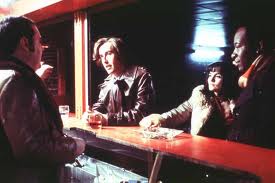

In my head, 24 Hour Party People was a totally different film. I can't think now of what I was getting it confused with, but it certainly wasn't what I watched, which is why I put it off for so long. The story of the Manchester club and music scene in the late 80s and early 90s, the film primarily focuses on Tony Wilson (Steve Coogan), a journalist who becomes a budding promoter and club owner, brought up and down by his own hedonistic decadence and belief in himself, at the same time seeming to compromise the very vision he pioneered and propagated. Looking also at the rise and fall of bands such as Joy Division, Happy Mondays and New Order, it is a fascinating and very entertaining look at this time, filled with frequent fourth wall breakages to insert actual memories and commentary on the time. Director Michael Winterbottom and writer Frank Cottrell Boyce both work splendidly to create this masterful biopic of an era, as told through one man. 4.5 stars.

Monday, 4 October 2010

Round Two of Five At Once.

Right, I'm fairly well on record on not being Christian Bale's biggest fan, but this DVD was fanging about in the living room and I had nothing to watch and I kept hearing such great things about, and about his performance (I'd heard similar things about his showing in American Psycho, and we all know how that panned out...) I think the points given to him in The Machinist are for his weight loss, which yes, while demonstrating incredible commitment, also demonstrates a level of insanity - boy, that's going too far. And he still seemed like Christian Bale. Emaciated, but still him. An interesting tale of being haunted by your conscience, it might have played better if Fight Club hadn't done such a bang up job a few years earlier. I remember being a little scared in a few points, but I shit myself over anything. 2 stars.


Have I mentioned that I love Atom Egoyan's name? Yes, I think I might have here. His name will always draw me to his films. Of course, whacking Julianne Moore in there is going to go a long way towards me heading out to see it also. I liked The Sweet Hereafter, but not so much Chloe. It was fine, I guess, but it didn't grab me the same way. The family drama was all a little off. Moore was terrific, as always, but I didn't quite gel with Amanda Seyfried and Liam Neeson. I just don't think they quite worked. (Max Thierot was cute though...) And the cerebral nature of everything kept it all a little cool and distant - the white rooms and glass everywhere, I can see where it was going with the kind of sterile environment and how that plays against the drama within, but it was all a little too much. It was a fine film that could have been great but in the end I feel that it missed it because of lazy visual cues. 2.5 stars.


Man, I totally don't even know where to start with Aguirre: Wrath Of God. Werner Herzog is one crazy, crazy guy. Like, seriously. Nuts. Brilliant, but loopy. I definitely don't think I can contain all that is this film in such a nutshell. Klaus Kinski is the titular Aguirre in a South American expedition to find El Dorado. He takes charge, seizes power if you will, and leads his troops or whatever onwards against all common sense, coming under attack from all sides, until eventually his men are hallucinating and he is proclaiming himself the wrath of god whilst covered in monkeys. No, really. Herzog really laid the groundwork for many of his latter films with this one. Kinski is terrifyingly mad, Herzog is terrifyingly creative, and the film somehow works for it all. It's mental, absolutely mental, but such a riveting piece of filmmaking, and seemingly such an influence on films such as Apocalypse Now (I'm seeing it - anyone else?)(In looking back, that's another film I watched and didn't write up. Damn.) 4.5 stars.


This is a film I really want to spend time on. But I must be strong. Abbas Kiarostami is a genius, he really is. I really enjoyed Close-Up, I loved loved loved Taste of Cherry, and now I really liked Ten as well. His is an oeuvre I really need to explore in much more depth, and repeatedly. Here, he has ten episodes of customers (or a son) in the passenger seat of a van, driven by their psychologist, who is interacting with her as she drives them around Tehran. It's such a simple concept, all taking place within the car, but it is a masterclass in what can be achieved with so little, and so simply. It is truly beautiful and a wondrous look at the often ignored stories of the women in this part of the world, opening them up not as victims of repression but as people just like the rest of us. Without it ever feeling like that is what is going on. Truly marvelous. 5 stars.


The major thing I can say about Food, Inc. is that is has changed the way I eat. Literally. I pay so much more attention to it now. To where my produce is coming from. To its content. I'm shopping more at farmer's markets when I can, but when I can't I'm doing everything within my means to make sure I pay attention to the lessons learnt from this film. Because they are many. The film follows in the footsteps of other docos like The Cove that are truly terrifying, particularly affecting (I've only eaten salmon twice since watching The Cove, and I used to eat salmon a lot. And they don't even mention salmon!) I can't recommend it highly enough, but be prepared to be very challenged about your habits. As a look at the global food industry, it is a horrifying exposé. Overly didactic and preachy in parts, perhaps, but when dealing with a subject as important as this one, a little bit of ramming down the throat probably doesn't go astray. 4.5 stars.

Sunday, 22 August 2010

Not Quite Stealing.

She has a bunch of César awards, a Golden Lion, has been up for a few Golden Bears and a Palme d'Or. But never an Oscar, though if my memory serves me correctly she was on a longlist a couple of years back. Who is it? Why, Agnès Varda of course! An influence and marginal precursor to the French New Wave and member of the Rive Gauche movement, married to Jacques Demy. One of only five people present at the burial of Jim Morrison in fair Paris.


Now, she is kind of old. Her hair is greying, her hands are wrinkling. But this doesn't stop her from making powerful films, such as her 2000 title The Gleaners & I (Les glaneurs et la glaneuse.) For those not in the know, gleaners are those who glean, who go through the detritus or the ignored, who wander into unexplored or public areas, who look where no one else has bothered to find things of value. This can be out of necessity for the poor (that homeless man rummaging in the bin for an empty aluminium can? Gleaning) or to obtain a culinary edge (René Redzepi of Copenhagen's Restaurant Noma famously 'forages' for foods - gleaning.) It can be for interest, for collection, or for environmental reasons - recycling the old rather than constructing the new.


Varda narrates her own journey into the world of gleaning, going through the French countryside and discovering the various people doing the various gleaning things they do. She looks at the laws surrounding gleaning, the people and companies who encourage gleaning, and those who go out of their way to stop it. But the most fascinating segment of the documentary involves her analysis of her own gleaning ways. Her view that, with her camera, whether making films or documentaries, she is gleaning from the reality of the world. She is gleaning moments, ideas, inspirations, beauty, horror, whatever. And it is a true and wondrous way of contemplating her own space within the world, as a leading filmmaker of the last fifty-odd years. It spins a whole different light on the actions of any artist - we're all just gleaning off someone else. That line of dialogue you overheard on the bus and is now in your novel? Gleaned. The framing of that shot reminiscent of that painting you saw in that gallery one time? Gleaned. In the same way that every story has been told before, every shot has been composed, every note played, every thought framed. And we're all just gleaning off each other, hoping to be able to form them into a new mould. Or a mould in a different shape, constructed, as it is, of many existing fragments.


It is this idea, rather than the interesting but otherwise somewhat bland notion of following a bunch of foragers, that makes Varda's film eminently watchable. Her constant parallels to her own activities, and her lack of compunction when it comes to scenes such as the dance of the lans cap (watch the film and you'll understand) show a bravery towards her own artistic tendencies and a belief in her own abilities, both to glean and create. The dancing lens cap, for example, can be said to owe a debt to Sam Mendes' dancing plastic bag in American Beauty - is its inclusion therefore gleaned? Or is it a lucky mistake?


Surprisingly, watching a seventy year old French woman roam the countryside is gripping and beautiful, much more than geriatric films generally are for those of a younger age. Varda brings her character and life to the forefront, gives us everything she has learnt (or gleaned), and teaches us something about each and every one of us. 5 stars.

Saturday, 21 August 2010

I Humbly Beg You, Show Mercy To These Men.

In all my years, to never have watched Paths Of Glory. I can understand my reticence to pick up Barry Lyndon, it looking so unlike the Kubrick we all know and love, but to ignore his breakout film? The film that got him the Spartacus gig? Which in turn allowed him to go on to be possibly the greatest filmmaker to have lived? For shame. 


But now rectified!


Paths of Glory wasn't Kubrick's first feature (that honour belongs to either The Killing or Killer's Kiss, depending on whether you count the latter as a feature due to its run time - which in turn probably depends on the version you're watching), but it was his first to really make people sit up and take notice. I'm sure no small part of this is due to the casting of Kirk Douglas, who was just about to receive his third Oscar nomination in less than a decade - though not for this film.


Douglas plays Colonel Dax of the French military, commanding troops against the Germans in the First World War. General Broulard (Adolphe Menjou) orders his subordinate General Mireau (George Macready) to send his troops on what will effectively be a suicide mission to capture the strategically important Anthill. Mireau in turn orders Dax to take charge of this operation, having had his opinion swayed by the promise of promotion. Dax resists but eventually follows orders, leading his troops onto open ground where the majority are promptly slaughtered. Some troops even refuse to leave the trench, under such heavy fire that they know they will get nowhere, inspiring Mireau to order his artillery men to open fire on his own troops to inspire them to charge. The artillery men refuse without written orders (as is protocol), infuriating Mireau, who decides to execute 100 of them for treachery. Broulard manages to convince him that three would be enough, one from each company, to make an example.


The three are selected for various reasons - one to cover up a grave error by his superior; another because he is a 'social undesirable'; and a third just by pure bad luck, despite the fact that he is a valiant and courageous soldier. Dax, a lawyer in the civilian world and outraged by what is happening considering the suicidal mission they were all sent on, takes it upon himself to defend themselves in the court martial that is convened to try them. The court martial is a preposterous affair, however, and branded such by Dax, who fails to get the men off. Dax does repeatedly try, submitting further evidence to Broulard in order to try and sway for clemency, but he fails every step of the way. Ultimately, Broulard offers Dax the promotion he was going to give Mireau (after indicting Mireau for the order to attack his own men), prompting Dax to violently challenge Broulard on his assertion that this was all in order to move up the ranks - Dax has always had his men's best interest at heart, and is disgusted by any inference to the contrary.


It is a powerful premise and a terrifically executed story. Douglas is magnificently torn and conflicted, struggling with navigating his own best interests, those of his men, and how best to make his way through the intricate labyrinth of the hierarchy of military life. He knows it is unfair, but he also knows kicking and screaming means nothing in the army. If proper protocol isn't followed you may as well just hand yourself over for a misconduct charge.


Menjou, Macready and the entire support cast perform very well. The three men on trial present entirely opposite faces to the world, perfectly matched to provide a snapshot of human nature in the microcosm of an army jail, and  played wonderfully. 


Shot in and around Germany, with Americans playing French military, it is a little discombobulating to watch at times, but a little suspension of disbelief allows you to fall into the world Kubrick has created. Maybe not entirely, but as discussed before (here, here and here), he never truly lets you fully into the sphere of the film, instead too happy to keep this world at arm's length from the audience. In this world the maestro is unafraid to show off the stylistic flourishes that would become his trademarks - the faces, the tracking shots, the thematic struggles - all in the wonderfully constructed world of trench warfare and palatial court-martials. 


A riveting film in every way, Kubrick did more than make his mark with this film - he shouted to the world that he is here, and he is not going to stop. And thank god for that. 5 stars.

Friday, 20 August 2010

I Loved The Taste Of Blood Since I Tasted Yours.

I derive joy from simple pleasures. Like knowing that what is often thought of as the pioneering film of the French New Wave, Hiroshima, Mon Amour, was nominated for an Oscar. Strange it wasn't nominated for Foreign Language film (though that may well have to do with the submissions procedure), but for Best Original Screenplay for Marguerite Duras. Of course it lost (to Billy Wilder's The Apartment, which took home Best Picture also), but it did get a BAFTA (the UN Award - what the?)


Alain Resnais' 1959 masterpiece was widely acclaimed, coming around the same time as François Truffaut's The 400 Blows and just before Jean-Luc Godard's seminal A bout de souffle. Resnais brought in the jump cut between memory and present, as well as keeping his story of love in another country very simple. He (credited on imdb.com as Luis but given no name in the film, played by Eiji Okada) is an architect in Hiroshima, who was on active duty when the bomb hit, but whose family all lived in the city at the time. She (similarly, her name is Elle, played by Emmanuelle Riva) is an actress in Hiroshima for 36 hours only. The two begin a passionate affair despite the fact that they are each otherwise married. But the film doesn't focus on the words these two speak of and too each other so much as what is said about the city. It is almost as though Resnais and Duras are attempting to heal the damage done fourteen years earlier, using love as the bandaid. And it is beautiful. As the film progresses it seems entirely plausible that their feelings could possibly undo all of the damage bestowed upon the city.


Of course it can't, and in the final scene, which heavily references Casablanca, it becomes apparent that all good things must come to an end. But, like Casablanca, the memories will last a lifetime - they may not have started a beautiful friendship, but they will forever hold in their hearts the few hours they spent in carnal embrace, discussing the world and their names as cities.


The Japanese sections in particular were beautifully captured by Michio Takahashi (the French segments captured as flashback and memory by She were shot by Sacha Vierny), and the whole film wove its way into my consciousness like not many can. Resnais' crafting of the structure, and the way it was all cut together by a team, gave it a freshness that still holds firm fifty years later. The realness that somehow permeates through the artifice of the medium is striking - I do think it strange that the jumpcutting in this film and in A bout de souffle in fact seem to be the realest ways to portray humanity, despite the almost Brechtian selfawareness they by nature have.


It is a beautiful example of how simple cinema can be whilst saying absolute volumes. There is a good reason why this film is held up somewhere near the pinnacle of film. This is a film I look forward to revisiting time and time again, as I'm sure that every time something new shall shine through. 5 stars.

Monday, 16 August 2010

I'm Giving You A Spade. A Spade.

Man, Taste of Cherry has been on my radar for so long now, and I can't believe I've never watched it. I'm entirely ashamed of myself, in fact.

In the three Kiarostami films I have watched over these last nine months or so (we had this one and we have 10 coming up also) there is a very, very distinct style, and even setting. They are all digital video, they all feel like documentaries (though I'm never going to label any but Close-Up as even approaching mockumentary) and they all have a lot to do with cars. Well, they are all set for a large part (or, in the case of 10, for the whole part) in or around cars. I am therefore intrigued to the max with Kiarostami's first non-Iranian film, Certified Copy, which from the trailer seems bright, glossy, and features Juliette Binoche. We shall see.


Taste of Cherry centres on Mr Badii (Homayoun Ershadi), a man with a suitcase of money driving through Tehran trying to find someone to help him die. That's not entirely accurate, actually. He is not looking for someone to help him die, merely for someone to bury him once he has died. He confronts a few people, from a boy in the military to a seminarist from Afghanistan before coming upon a taxidermist, who says that he will help though he tries to talk Badii out of it beforehand, revealing that he had tried to commit suicide earlier in his life and was now glad that he hadn't.


It is a very simple conceit for a film, but with Kiarostami's deft touch (something which, according to the cover notes for 10, saw him voted the most important director of the 1990s by a collection of leading international critics - I'm not going to argue, despite the fact that this was unreferenced...) it becomes something incredibly beautiful and complex. After seeing the film, the title itself brings emotion bubbling to the surface, coming as it does from a beautiful little monologue during the film:


If you look at the four seasons, each season brings fruit. In summer there's fruit, in autumn too. Winter brings different fruit, and spring too. No mother can fill her fridge with such a variety of fruit for her children. No mother can do as much for her children as God does for His creatures. You want to refuse all that? You want to give it all up? You want to give up the taste of cherries? 


And all this while Badii is being given directions by his passenger! Coming as it does within the mundanity of 'turn right', 'turn right', and the pauses between these directions, gives such beautiful words added poignancy and beauty. 


It is hard to truly do justice to something so beautiful, yet so simple, by talking about it. Taste of Cherry won the Palme d'Or in 1997 (tied with Unagi) and picked up a couple of critics awards for foreign language film in the States that year as well. It is soft and subtle but touching in many ways. It's probably one of the best films I've seen over the last year as well, and considering I just counted that I've seen 223 since I started this on November 9, that must be saying something. Kiarostami is, and shall be forever more, very high on my list of directors whose work I must absorb as much of as possible. 5 stars.


(Did I really say 'intrigued to the max' up there? I am so, so sorry.)

Sunday, 8 August 2010

If You're Not An Activist You're An Inactivist.

In the lead up to the Oscars earlier this year there did really only seem to be one title that would take out the Best Doco prize. The Cove won pretty much everything in the lead up, from critics awards to audience awards at Sundance and Sydney Film Fests. There were contenders of course (I've just watched Food, Inc., which was also very good and will be up on here soon) but The Cove seemed to just grab people and not let them go.

And it's a damned good film. Even excluding it being a documentary, it ranks among the best films of the year, narrative or otherwise. This isn't just a good documentary - it's a thrilling and terrifying motion picture.


Ric O'Barry was the trainer of the dolphins for the original Flipper television series. However, after one of his dolphins 'committed suicide' in his arms one day he suddenly turned around, becoming an advocate for dolphin freedom, despite all of the work he had put into them becoming such popular entertainment in captivity. To this end he is followed to a little town called Taiji in Japan, where he is very well known for his attempts to expose and stop not only the capturing of dolphins for use in dolphinariums, but also the horrific slaughter that takes place in a hidden cove surrounded by unforgiving cliffs and entirely sealed off from prying outside eyes.


Director Louie Psihoyos and O'Barry set about exposing the truth of what is going on. They are motivated not only by the animal rights aspect, but also the sever health issues associated with eating dolphin, which is being sold as whale meat around the country and is even being pushed into schools for lunches. Dolphin meat contains very, very high levels of mercury, and no one wants a repeat of the Minamata incident of the 1950s.


So, the pair assemble a crack team of various skills to set about capturing footage and sound of what is going on. They have the world champion freedivers, who are going to plant cameras and microphones under water. They have help from Industrial Light And Magic, making false rocks to hide cameras in. People help them smuggle in equipment that is really only for the American military. All of them pitch in, risking a lot including being arrested, to help Ric uncover the truth. And it is a shocking, shocking truth, very confronting.


Psihoyos has crafted a terrific film in The Cove, utilising the conventions of heist films and thrillers to keep you on the edge of your seat. Under cover of darkness, with cameras picking up heat to warn of approaching guards or police, with Ric playing decoy, the team go in to plant all of the items, and it is tense! It's tense like any Hollywood blockbuster would hope for, but then it's also real.


It was one of the more riveting documentaries I've watched, not reliant on the standard talking head because everything else they're doing is so damned interesting. There is just so much intrigue and action going on. A remarkable achievement.


And, it must be said, I went to my supermarket a few days later to buy salmon and caught myself making sure it was farmed, worrying about whether or not I should be eating it at all, thinking about dolphins screaming underwater. It was a good film with a message that resonated deeply and strongly, and will continue to do so, I hope, for a long, long time. 5 stars.

Friday, 6 August 2010

I'm Gonna Ride In A Circle.

I'm not sure how to go about writing about Andy Warhol's Lonesome Cowboys. I mean, do we treat it as art or artistic film? I mean, film is art, right? So are they not the same thing? But when looking at something by, say, Warhol, acting within the filmic sphere, should we be looking at it with different eyes, examining it from the traditional art-on-walls angle? Or should it be treated in exactly the same way as any other film? But what of installation film work? And who is to say that there is, again, any true difference between that which is displayed in an art gallery and that which is displayed in cinema? Perhaps one is meant for greater mass consumption, but can the same not be said within any artform?


I first say Lonesome Cowboys many years ago, underneath a cafe in Sydney. People kind of came and went (it wouldn't surprise me if I did the same), treating it more as an art installation. It didn't help that the third reel was six seconds out of synch - I timed it. My primary memories are of a fairly instant infatuation with Joe Dallesandro and that hot hot shower scene with Tom Hompertz.


This time, however, I noticed not a lot more.


Ok, that's not fair. I quite like the film in the sense of it as an installation, as a piece of art as opposed to a cohesive piece of narrative entertainment. There is just far too much liberty taken with the generally accepted notion of structure and exposition for it to truly be considered in the same sense that one may consider any of the other almost-200 films you can find on here. 


Isn't. He. Pretty.


Sure, there are parallels to Romeo and Juliet, but they're very broad-sweeping. The characters are for the most part either caricatures or barely there. It is more like Warhol and uncredited co-director (and writer) Paul Morrissey called up a bunch of pretty boys and said 'hey, come have a party in the desert with us and a bunch of other pretty boys and a whole heap of drugs, and we've got a camera and every now and then we might ask you to look in a certain direction and say something but it's all a bit of fun, right, here have a line.'


While that sounds like the biggest pile of dog turd the world may ever have seen, it functions very well within the artistic environment it drew from. Or almost as an examination of it in itself. It's almost more of an historical documentary, perhaps. Warhol and Morrissey appear in the film courtesy of directions and instructions given from off camera, and for much of the film the actors (for want of a better word)(ok, performers, I found a better word) seem either totally at ease or entirely bemused by everything that is going on around them. Only Dallesandro seems to be putting at least part of his back into it, and (may Joe forgive me) I think that detracts from the overall experience. Perhaps his desire to be a real actor or something saw him take this a lot more seriously than anyone else involved with the film, and that provides the film with its biggest weakness - someone who cares.


Overall, it's a terrific film to have on whilst you're doing something else. Cooking dinner, chatting with friends, staging a coup, participating in a drug-fuelled orgy - whatever. Treat is as you would installation art. And damn it, make sure you don't miss that shower scene. 5 stars. (As art, not as a film. As a film, 1.5 stars.)

Thursday, 5 August 2010

Why Does The Earth Have Colours?

With The Tree Of Life proving to be the most anticipated title of (insert any year from 2009 to 2056), I thought I may as well have me a little Terrence Malick fest. And a little fest it shall be - this is my second on here after Days Of Heaven, and that takes me to half of his released filmography as director. And I saw The Thin Red Line years ago, though I think I'll hit it up again. Leaving only Badlands to go.


So, which title could I possibly be talking about here? Well, considering there are so many to choose from, I'm going to stab and say The New World. Bullseye.


Pretty, huh? I don't normally find Colin pretty. But here? Pretty.


Considering the enormous gaps that can happen between Malick's films, and the fact that they are generally very good, the weight of expectation heaped on them can, I think, often be excessive. I think he fell prey to this weight with this, his fourth film. The reviews, when they came out, were decidedly mixed, though it's also worth remembering that the original version shown to critics is altered (and by a solid fifteen minutes of runtime, not to mention how the remaining footage might then have been changed) from that which was eventually released in cinemas. I personally loved the film, and I did go in with the expectation (there's that word again) that I would be quite disappointed, or at the very least underwhelmed. So there you go.


Malick, with his fourth film, tackles the founding of Jamestown, Virginia, incorporating the tale of Pocahontas (Q'orianka Kilcher) and John Smith (Colin Farrell.) I must confess, I know absolutely nothing of this tale. I've never seen the animation, and I never studied much American history. If, prior to my watching this film, you had asked me who Pocahontas was, I would have been able to tell you that she was the main character in a Disney film and not much else. This may have made the whole thing fresher and therefore more easily digestible for me - perhaps those with fond recollections of the previous treatment of this legend do not appreciate Malick's wistful and sometimes scandalous, as well as somewhat mythically adapted retelling.


In a similar way to Days of Heaven, The New World doesn't attempt to engage the viewer through a true and dramatic narrative. Rather, it is again a film you feel your way through, you see your way through, rather than following the narrative checkpoints and emotional and character arcs. Malick's floating and drifting camera (masterfully utilised by the incredible Emmanuel Lubezki, who I will say again is criminally underrated, mentioned again here and here) seem to not lead the way through the jungle of the period, but rather happen upon important moments that allow you to piece together what is happening. It's almost like he's drifting about with a camera, shooting the sky, and every now and then he loses focus and the camera falls to the level of us mere mortals, and we happen to notice something important happening before the fascination returns to something beautiful near the tree tops, or in the reeds. But what you see is always so wonderfully informed, and matched by a fragmented yet touching voiceover that lets you totally inhabit the new and unknown world our characters are inhabiting.


The highs and lows of the Smith/Pocahontas relationship are mapped alongside the horrendous conditions surrounding the foundation of the town. Kilcher was oft talked about for Oscar, though she didn't really manage to pull through with anything particularly major despite a fantastic performance. But then again, no actor has ever managed an Oscar nod through Malick. Farrell wasn't even mentioned except in passing from what I remember, though he gives quite a solid performance. His role isn't overly dramatic, but it is always there and full of meaning - I think he pulled off a much bigger performance than he is given credit for. He has a lost and confused look in his eyes betraying the fear and discomfort he feels in the space he finds himself in. He is not a confident and fearless leader, he is in love but he is scared shitless, and he gives me all of that even whilst doing very little.


The cinematography was marvelous. Did I already mention that? Won't someone please clone Emmanuel Lubezki, raise one copy on a pedestal for all to admire and set the rest to work shooting every film they can? Please? Thanks.


The supports were all good as well, and I did really like seeing Ben Mendelsohn. I like seeing Ben. He's very good, you know. And, wait for it, a Christian Bale role that I liked. Another one! That's two Bale films in a row! (Though made many, many years apart...) I thought he was magnificently understated and very controlled, and very warm, very real. And those are not words I generally associate with Mr Bale. I was très impressed. Impressed enough to use French, no less.


James Horner's score, or what was left of it by the time Malick kept cutting and changing and cutting and changing, was really very good, and I'm not a huge fan of James Horner scores as a general rule. So that was nice.


I really liked the film. I might even go so far as to say loved. I did at the beginning, so why hold back here. It was a beautiful, moody look at history. It may not have been true, but who cares! It was touching, it was stunning, it was moving, and it kept me watching every second. 5 stars.

I'm Taking Pills And Getting Injections.

Ok, so I quite literally know every line from Notting Hill. Well, maybe not 'quite literally', but it'd be damned close. Close enough to piss off anyone watching the film with me (except one person, who also knows ever line.) I used to be embarrassed of my love of the film, back when I was young, innocent and at film school, but now that I'm older and realise that I have seen it more than any other film I am more than happy to include it in my list of favourite films of all time. Do you hear that? I AM NOT ASHAMED!


Ahem. I love it. There was a time when I'd watch it at least monthly, if not more often. This is the first time, I think, that I'd watched it since leaving Australia, though I may have watched it earlier last year.


I do have to stop myself from tearing up every time I watch this scene. For real.


I don't know what gets me about the film. I am a fairly devoted fan of Julia Roberts, here still only recently out of her mid-90s period where nothing really seemed to go as well as everyone had hoped, and playing a character that was totally a premonition of the person she was about to become, clutching her Oscar and to be seen filming most days on Hampstead Heath. Hugh Grant I can generally take or leave, but here he is given the perfect role, where he can pretty much play what he has always played opposite a beautiful and talented leading lady with a director (Roger Michell) hitting his stride and a gifted screenwriter (Richard Curtis) buoyed by an Oscar-nomination for his last rom-com. 


Roberts is Anna Scott, the biggest film star in the world. Grant is William Thacker, the owner of an unsuccessful travel bookshop, which only sells books on, well, travel, and to be quite honest doesn't always sell many of those. He spills an orange juice on her in the street, accidentally calls her a prostitute and the rest is history. What makes it work so damned well is the fact that I'm quite certain that every character was written specifically with the actor who played them in mind. And the collision of some hilarious writing, soppy sentimentalism, outlandish hope and a happy ending proved too much for the world to resist - it did take over USD$350mil worldwide back in 1999, which is, well, that's pretty good then, really.


I don't really have much more to say about it, though. I mean, I'm sure there are faults in the film that I could pick out if I wanted to, but I don't want to. I love it. The end. One day maybe I'll sit down and do a blow-by-blow, moment-by-moment analysis of what gets me in each scene or shot or something, but for today, just accept my love. And couple it with the knowledge that I know have an almost overwhelming desire to watch it again, just by talking about it. That's how much I love it. That much. And no one can talk me out if it. Believe me, people have tried. 5 stars.

Tuesday, 13 July 2010

The Audience Left Twenty Years Ago.

Sixty years ago (almost to the day) Paramount released Billy Wilder's Sunset Boulevard, a scathing and withering look at Hollywood star culture, into a film world dominated by cheese, contract players and nothing with any great depth (speaking, obviously, broadly and directed towards the major studios and their dominant popular fare.)


Norma Desmond (Gloria Swanson) was a huge silent film star but is now an old and lonely faded celebrity living in a mammoth, gaudy mansion on Sunset Boulevard. A struggling journalist, Joe (William Holden), on the run from a pair of thugs attempting to repossess his car, turns into the driveway of the house with a flat tyre and ends up being drawn into Gloria's deranged world. She is convinced she is still a star and entreats Joe to help her write the screenplay for her triumphant return to the thousands of people she is sure are waiting breathlessly for her reappearance. Joe, being in a dire financial position, is in no position to say no, and ends up being drawn into the lavish lifestyle Norma provides for him. He is intrigued by her frailty and her belief in herself at the same time as a large part of him is simply indulging her fantasy for as long as he is able.


Joe begins working on another screenplay at night, leaving the mansion to write with Betty (Nancy Olson), a girl he met at a party. This upsets Norma greatly, as she is not only deluded by her own popularity and power within the world of entertainment, but also fiercely protective. Joe does feel guilty for his deception, especially due to his financial dependency on Norma, but he gradually manages to prise himself loose. Norma is missing calls from Paramount, assuming that they wish to finance her completed script, but when it is revealed that the studio merely wants to rent her car for a shoot, her butler and ex-husband Max (Eric von Stroheim) insists on keeping the information from Norma, in much the same way as he keeps from her that he is writing the vast majority of her fanmail. 


Quickly deteriorating mentally, Norma finally loses it all, committing a crime and being arrested at home in front of an enormous number of the press, vultures intent on picking over the corpse of Norma Desmond's career and sanity. She is convinced that these people are here to support her return to the screen, and after descending the staircase closes the film with one of the most memorable lines in cinema history.


Billy Wilder and Charles Brackett co-wrote the script, though only the first third was written when filming began, perhaps explaining how they got away with it. The film's narration (from Joe) does feel hack-ish, but this is totally accurate considering it is coming from the self-confessed hack himself. Norma has the best, most iconic lines, with Joe matching them with dry retorts and sarcasm. For a film put together as it went, the script is terrific, netting Wilder, Brackett and DM Marshman Jr an Oscar, to go with those handed to the art directors and composer Franz Waxman.


All of the lead actors deservedly received Oscar nominations for their terrific performances. Swanson, playing something close to herself, was superb, matched by Holden perfectly, who had to be forced into the role using his performance contract. Wilder draws them in and on, and brings the audience into the horror of the world of dead celebrity perfectly, capturing the fear, desperation and loneliness after the cameras have gone, brutally savaging the world of celebrity that has only become monumentally worse.


5 stars for this classic of cinema and tremendous achievement.

Monday, 12 July 2010

He's Heading Towards Certain Death.

I really didn't know what to expect when I picked up Werner Herzog's Oscar nominated Encounters At The End Of The World. I figured that I would end up watching an interesting and somewhat unique documentary about Antarctica, having learned from Grizzly Man that Herzog isn't your standard documentary filmmaker. I didn't expect to finish having experienced one of the most heartbreaking scenes I've seen on screen.

I'm sure anyone who has seen the film knows what I'm talking about. The suicidal penguin, the penguin who stands, seemingly momentarily confused, before choosing not to follow his fellow penguins and instead begin his solitary trek inland towards certain death. That lone penguin, scampering across the ice, wings outstretched and exaggerating that almost comically pathetic waddle. A black speck on a frozen ocean of white, perhaps deciding that enough is enough. And with Herzog's narration, with his particular views on humanity behind it, the scene is devastating, poignant and all too human.


Herzog took his camera and a cinematographer to McMurdo, the American outpost in Antarctica, a town Herzog describes in no uncertain terms as fundamentally depressing. He outlines what his film is going to be about - it won't (despite the above reference) be another film about fluffy penguins. He is concerned with humanity, with the people who are drawn to this lonely, desolate continent at the bottom of the world, with why they are there, what stories they may have to tell and how they survive so far from... well, everything.


He takes an incredibly unique and interesting view. He doesn't overly judge the people (though his dry commentary does often give some indication as to the humour he must feel regarding some of the personalities he encounters), simply allowing them to tell their stories, and contrasting them to the setting they are within. This setting is not merely the unattractive town, but the stunning beauty of Antarctica we all remember from films such as that one about the fluffy penguins. Herzog also ventures into the water, however, and not merely for the seals (though the sequence on their calls immediately makes me think of The Cove, which will be coming up shortly here...) but also to look at the beauty of single-cell organisms being newly identified constantly, forming beautiful, artistic shapes, with discussions on their intelligence. Herzog invariably manages to bring all of these natural wonders back to analogies about humanity, a feat that cannot be taken lightly and which proves ultimately incredibly interesting.


Yes, a lot of the film feels a little like pop psychology, but the insights and postulations are thought out and presented by Herzog as options rather than conclusions, opening a dialogue with the audience and allowing the viewer to completely fall into the film, emotionally and intellectually invest rather than simply passively enjoy. I left the film affected, though I couldn't begin to explain how. Thinking back on the film now it somehow has more weight than other films, it lies heavier on my body than most that I have seen. Similar to an incredible and powerful drama, which renders you paralysed and forces you to contemplate everything about and around yourself, Encounters At The End Of The World isn't a light film, despite its ostensibly light matter. It is far from depressing, in fact it is very enjoyable, but expect it to hit you far deeper than you might have thought. 5 stars.